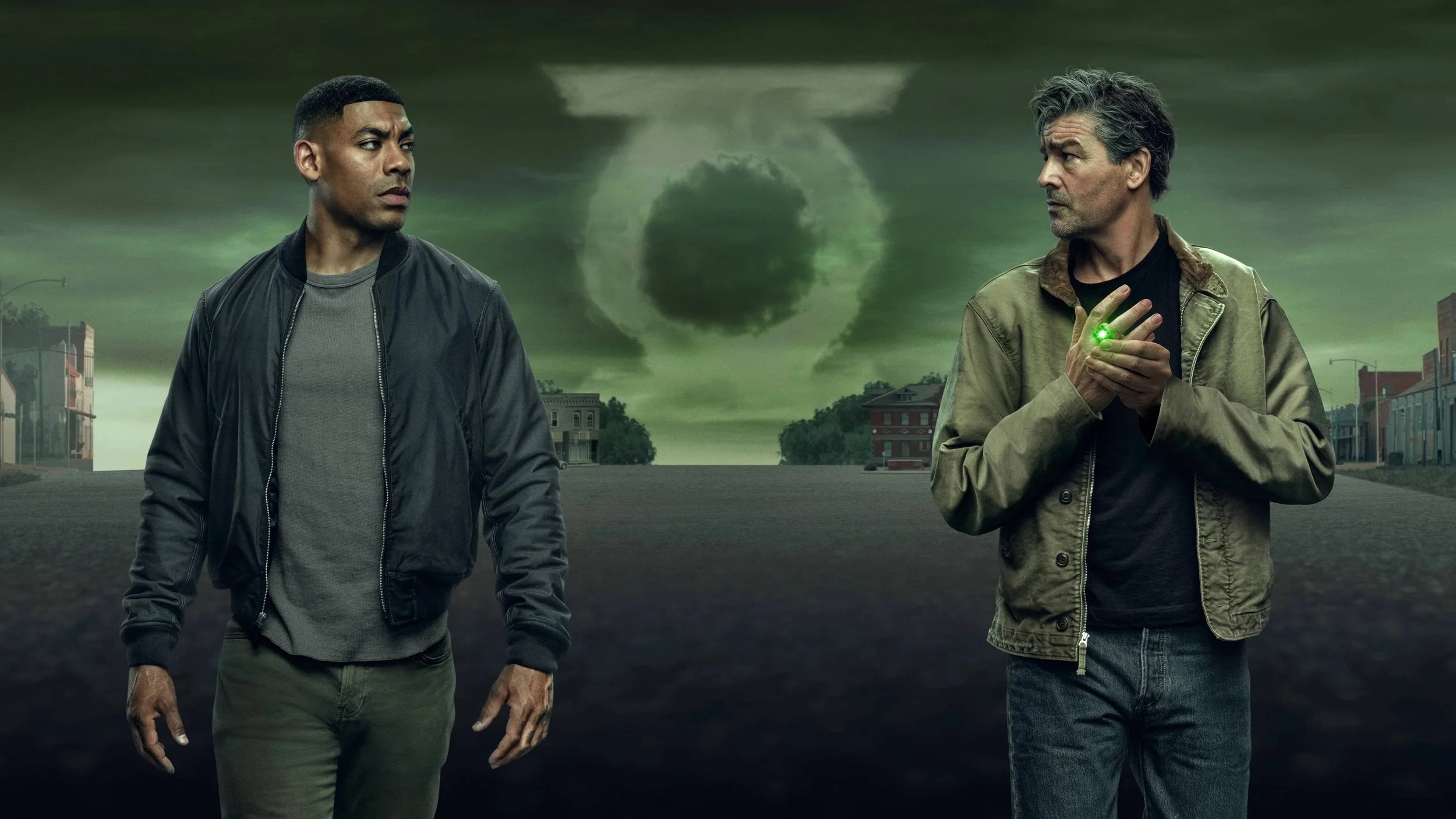
WARNING: This article is LONG! What began as just another critique kept growing alongside the show’s stupidity until it eventually became the behemoth you see before you. At this point, I’m posting it more out of posterity, as I know it’s unlikely anyone will actually read it. (Maybe someday I’ll post an abridged version)
Green Lantern deserved a series worthy of its mythology. Instead, we got a murder mystery that sidelines its own superhero premise, a succession of contrivances masquerading as character development, and a creative team that seems more interested in explaining what its story means than making the story itself work.
There was a time when the announcement of a live-action Green Lantern series would have been cause for genuine excitement. Here was an opportunity to explore one of DC’s most imaginative corners: an intergalactic police force, cosmic tyrants, ancient Guardians, competing emotional spectrums, alien civilizations, and beings capable of transforming willpower into virtually anything they can imagine.
The Green Lantern lore is practically a television writer’s dream. It can support space opera, police procedural, military science fiction, intimate character drama, and philosophical arguments about courage and fear. The ring is one of the most versatile tools in superhero fiction. Its possibilities are limited only by the imagination and determination of the person wielding it.
So what did the DCU do with all that?
Apparently, the creative team looked at an entire universe of extraordinary possibilities and decided audiences would rather watch a grim small-town murder mystery, a dead Green Lantern, an increasingly convoluted family drama, and a protagonist whose path to becoming a superhero requires him to take a dead man’s ring and disregard the organization that gives the role its meaning.
Welcome to Lanterns, a series that manages to make one of DC’s most visually spectacular properties feel like a joyless exercise in self-hatred. It is a show that wants the seriousness of True Detective, the emotional sophistication of a family tragedy, the thematic weight of a character study, and the franchise significance of a major DCU production. Unfortunately, wanting to be those things is not the same as accomplishing them.
A grounded detective story about Hal Jordan and John Stewart could absolutely work. Their contrasting personalities and experience offer a natural source of conflict. The Corps and the Manhunters provide a foundation for stories about authority, responsibility, fear, justice, and institutional failure. There is no shortage of material.
The problem is that Lanterns confuses making a character miserable with making that character interesting, making a story unexpected with making it intelligent, and making a thematic statement with earning that statement through the events of the narrative.
It has the ingredients for a compelling superhero drama. It simply cannot figure out what to do with them.
By the end of the first season, the larger failure is impossible to ignore. This is not merely a disappointing adaptation of Green Lantern. It is a series that seems uncertain about what Green Lantern represents, what makes its principal characters compelling, or why audiences would want to spend time with them in the first place.
Lanterns is the worst show of the year and a serious contender for one of the worst superhero shows ever produced. Not because every performance is terrible, and not because an adaptation must reproduce every comic-book panel. It fails because it repeatedly takes interesting ideas, makes them subordinate to its preferred message, and then expects the audience to mistake the resulting incoherence for depth.
A Prestigeless Drama
The most fundamental failure of Lanterns is the philosophy behind the storytelling underlying the production.
This is a series that clearly wants to be taken seriously, and behaves as though the audience should be impressed simply because it is not telling a conventional superhero story.
There are no obligatory triumphant speeches, so it must be mature.
There are long stretches of conversation, so they must be meaningful.
The characters are damaged, so they must be complex.
The narrative withholds information, so the mystery must be intricate.
Traditional superhero norms are discarded, so the result must be daring.
None of those assumptions is true.
Subversion is not inherently intelligent. A story does not become sophisticated by making its heroes unpleasant, its villains sympathetic, or its endings bleak. Good drama makes a character’s decisions understandable, even when those decisions are terrible. Good mystery gives the audience enough information to form theories, enough misdirection to make those theories uncertain, and enough clues that the eventual answer feels surprising but inevitable. They establish rules, introduce conflicts, and let consequences develop. The audience does not have to agree with a character, but it does need to understand why that character acts as they do.
In Lanterns, characters make decisions because the plot needs them to. Information appears when convenient. Established expectations are discarded when they interfere with a planned emotional revelation. And when a decision becomes too difficult to justify, the series reaches for trauma, legacy, fear, or some other suitably weighty concept, mistaking explanation for justification.
Consider the basic premise. Hal Jordan is an experienced Green Lantern, a veteran of an intergalactic organization entrusted with extraordinary power. John Stewart is a former Marine whose relationship with the Corps is tied to a family obsession that has shaped his life. They investigate a murder, an alien conspiracy, and a threat connected to the Manhunters, artificial enforcers created by the Guardians of the Universe.
That is more than enough material for a compelling season. Instead, the investigation proceeds through arbitrary discoveries, unexplained abilities, convenient omissions, and characters who seem to know precisely as much as the writers need them to know at any given moment.
The worldbuilding is introduced in fragments, often through conversations about events the audience never witnesses. Important revelations come after the story has already spent considerable time asking us to care about their consequences. The characters discuss an alien genocide without giving us a meaningful understanding of the civilization that was destroyed. A major revelation about the Guardians arrives without enough groundwork to make it satisfying. And events that should carry enormous weight happen offscreen.
This is not elegant restraint. It is an incomplete story masquerading as an enigmatic one.
The series also seems confused about what type of experience it wants to provide. It borrows the presentation of a prestige crime drama, but the mystery is not constructed well enough to sustain that approach. It wants the emotional intimacy of a character study, but its characters are so inconsistent that their developments rarely feel earned. And it wants the scale and wonder of a cosmic superhero franchise without committing to the visual imagination or explanatory groundwork it requires.
The show could have been a detective drama about two Lanterns. It could have explored the corruption of an intergalactic police force. It could have examined the relationship between fear, courage, authority, and justice. Instead, it feels as though it has been written around the idea that the superhero elements must be kept at arm’s length to preserve the prestige-drama atmosphere.
That is not a failure of the genre. It is a failure of the writers to reconcile the genre with the story they chose to tell. And because they apparently believe the seriousness of their subject matter will conceal the deficiencies in their execution, they rarely pause to question whether their own ideas actually make sense.
“The ‘Green’ Was Stupid”
The first baffling creative decision is the show’s apparent discomfort with the franchise it is adapting.
Green Lantern is a property in which the relationship between character and power should be inseparable. The ring is an external manifestation of willpower, but the lore has always offered room to explore what happens when willpower collides with fear, doubt, arrogance, duty, and personal weakness.
The ring is not merely a special-effects prop, it is a storytelling mechanism. Yet Lanterns spends eight episodes treating it as an inconvenience. It is so determined to prove that it can operate as a grounded crime drama that it keeps making the actual superhero premise irrelevant.
The cosmic setting becomes background information. The Corps is largely an offscreen institution. The Guardians, ancient beings entrusted with maintaining order across the galaxy, are treated less like an incomprehensibly old civilization and more like a committee of contemporary bureaucrats who only appear when the plot needs them. The ring becomes a wildly inconsistent tool. Sometimes its limitations are central to the suspense. Sometimes it seems to possess abilities that should make various predicaments trivial. Sometimes it is supposedly decommissioned, drained, or unusable, only to perform convenient functions when the plot needs another revelation.
And the constructs, the most recognizable visual feature of Green Lantern, are denied the imaginative possibilities that make the concept appealing. That would be disappointing in any adaptation, but it becomes particularly absurd when the alternative is so visually and conceptually bland.
In fact, there are only 16 constructs throughout the entire series:
$20 bill (Ep 1)
Bottle opener (Ep 1)
Bubble shield (Ep 1)
Bird (Ep 2)
Bubble shield (Ep 3)
Watch (Ep 3)
Drill (Ep 4)
Kettlebell (Ep 4)
Dome shield (Ep 4)
Bubble shield (Ep 4)
Riot shield (Ep 5)
Bubble shield (Ep 5)
Dome shield (Ep 5)
Ring shockwaves (Ep 5)
Tornado (Ep 5)
Bubble shield (Ep 5)
There are no constructs in episodes 6, 7, and 8.
The creators have discussed the challenge of explaining why characters with extraordinary ring-based abilities would not simply use them to resolve every problem. While that is a legitimate adaptation problem, it is also an elementary part of writing a superhero story. The solution is not to make the powers irrelevant. It is to create situations in which using them has consequences, introduces complications, or cannot address the actual problem.
Superman writers have been solving this for decades. Batman writers build entire stories around the limitations of a character who has no superpowers at all. Green Lantern writers have an especially versatile tool: the ring can produce almost anything its wielder can imagine, while still being constrained by knowledge, concentration, and will. But the Lanterns writers just want the recognition attached to the property without accepting the obligations that come with adapting it.
The creators have defended the decision not to end the season with a conventional superhero spectacle. In DC’s feature about the finale, Damon Lindelof explained that the production prioritized the relationship between Hal and John over a climactic action sequence, while Tom King emphasized their desire to avoid superhero clichés.
“If we had to make a two-hour Lanterns movie about this meeting of John and Hal,” says Lindelof, “[we] would have to have the third-act bombastic, amazing, action set-piece. Then you get two or three minutes of coda after that to do everything that Chris just said.
“We got to that almost over the course of three episodes—everything from the moment the Halogram first appears for John to process Hal’s death while solving his murder to where both characters need to get to in order to move on. You can only do that in TV. If you don’t have to do the big bombastic action set-piece, you have to ask yourself, ’What is it in service of for a show that was always about these two guys?’ It was just very liberating to know that we could do something like this instead.”
“One of our sticking points from day one,” adds King, “was ’No cliches. Avoid cliches like they’re the plague.’ As someone who consumes a lot of superhero content, that can leak into that content and make it boring and can give you the superhero exhaustion that we’ve seen a thousand pieces about.”
That is a defensible artistic choice in principle. A quiet finale can be more powerful than a battle if the preceding story has earned the emotional resolution. But rejecting spectacle does not automatically produce depth. Removing a final battle places greater pressure on the characters, dialogue, and moral conclusions. If those elements are weak, the absence of spectacle only makes their weaknesses more obvious.
The question is not whether Lanterns was obligated to end with a giant green fist punching an alien through a building. It is whether the story it chose to tell was compelling enough to justify everything it left out. It was not.
An adaptation does not demonstrate respect for the IP merely by mentioning its history. It demonstrates respect by understanding what makes that history meaningful and using it to tell a compelling story. If viewers have to keep asking why the ring is not being used in a Green Lantern story, the writers should be asking themselves what kind of story they have created. Instead, the lore is treated as a collection of references to rearrange around a pre-existing drama. That is not a reinvention, it is a failure to understand the assignment.
The Mystery Box Is Empty
The mystery surrounding Hal Jordan’s death is the season’s primary narrative engine. John returns to investigate, encounters the circumstances surrounding Hal’s final days, and gradually uncovers secrets involving the people of Rushville, an alien threat, and a deeply compromised family.
There is nothing inherently wrong with this structure. A mystery can be an excellent way to introduce an unfamiliar audience to a superhero universe. The investigation can reveal personalities, establish the world, and gradually expand a seemingly ordinary crime into something extraordinary.
But a mystery must be more than a collection of withheld answers. The audience should be able to look back at the conclusion and recognize how the clues, decisions, and earlier revelations fit together. Surprises should recontextualize what we know, not replace one set of unanswered questions with another. But Lanterns leans heavily on the emotional significance of its reveals while neglecting their logic.
The finale’s revelation that Sheriff Kerry Kane killed Hal to protect her son is meant to transform her from a complicated romantic partner into a mother who committed an unforgivable act out of fear and love. Noah’s identity as a Manhunter turns a local mystery into a story about alien identity and the possibility of choosing one’s own future. While those ideas could work, they do not relieve the writers of the responsibility to make the chain of events convincing.
The Manhunters are an even clearer example of the show’s storytelling problems. They are connected to the Guardians and implicated in the apparent extermination of an alien civilization. They are powerful and dangerous enough to threaten an entire community. Their existence should raise enormous questions about the origins of the Corps, the nature of intergalactic justice, and the consequences of entrusting autonomous machines with policing the universe.
Instead, the audience is left reconstructing basic facts.
What exactly happened to the Manhunters?
Why did they turn against their creators?
What were they originally programmed to do?
How did their mission become connected to the destruction of the alien population?
What did the Guardians know, and when did they know it?
Why were certain Manhunters destroyed while others survived?
The series thinks the existence of these questions is evidence of sophisticated storytelling, even though it has ample opportunity to answer them. The characters investigate the Manhunters, discover information about their origins, and encounter people whose lives have been destroyed by their actions. Yet so much of the relevant history remains frustratingly vague.
Take the alien genocide. A civilization is wiped out, survivors are motivated by revenge, and the threat of further mass death becomes central to the investigation. This should be one of the season’s most consequential storylines, but the audience gets little opportunity to understand the victims, their civilization, or the circumstances of the genocide. Their history functions largely as a plot device: another reason for the characters to argue, another deadline, another moral dilemma.
The surviving aliens also employ a bizarre tactic of killing themselves to take revenge on those they blame for their suffering. While that is a potentially disturbing concept, the show fails to explain the rationality behind such a decision.
A story that answers one question by creating five more is not automatically sophisticated; it is incomplete. Mystery-box storytelling becomes an exercise in frustration when the audience is left with disconnected mysteries and the hope that a future explanation will justify the present confusion.
Rogues’ Gallery
The writing’s weaknesses become most apparent in the characters. The central cast is populated by people whose choices are determined by whatever development an episode requires rather than by established personalities. They lie, conceal information, behave recklessly, and make decisions without receiving consequences proportionate to those decisions.
Flawed characters are good, but they also require balance. A character can be arrogant and still be heroic. A character can make a terrible decision and still be sympathetic. A character can even commit a serious crime and remain the protagonist. Superhero stories should be interested in the gap between power and responsibility. But Lanterns confuses explaining behavior with excusing it.
Some characters receive sympathetic explanations for conduct that would be condemned if done by anyone else. Others are subjected to punishment wildly disproportionate to their actual responsibility. The result is not a coherent examination of justice. It is a collection of judgments made in accordance with a narrative designed to demonstrate a certain theme, and the characters are placed in situations designed so their actions reinforce that theme.
Hal Jordan: The Deconstruction of a Hero
Hal Jordan is one of DC’s defining superheroes. He has been portrayed as a fearless test pilot, a headstrong officer, a reckless risk-taker, a flawed friend, and a man whose confidence can be both his greatest strength and his most dangerous weakness. He is not uncomplicated, nor should he be.
The tension between Hal’s extraordinary courage and his infuriating stubbornness is part of what makes him interesting. His confidence can carry him through situations that would overwhelm other people, but it can also make him dismissive of advice, resistant to authority, and unwilling to admit when he is wrong.
A good adaptation would use those contradictions to create someone simultaneously admirable and frustrating. It could challenge his arrogance without erasing his competence. It could reveal his weaknesses without reducing his heroism to psychological damage. It could allow him to be wrong while demonstrating why his experience and instincts make him an exceptional Green Lantern.
Instead, Lanterns seems determined to ensure that Hal’s virtues are perpetually overshadowed by his supposed unpleasantness. He is abrasive, unpopular, and constantly blamed for events that are not entirely his responsibility. We hear about his history through the filter of other people’s resentment, while rarely getting enough of his own perspective to judge whether their complaints are fair.
That creates an awkward disconnect between what audiences see Hal doing and what the surrounding characters insist he represents. He investigates the threat. He tries to prevent further deaths. He recognizes the danger posed by the Manhunters. He attempts to save people who might otherwise be killed. Yet the series repeatedly insists that he is a selfish, destructive presence whose involvement is itself a problem. And the audience is expected to accept that condemnation even when the events on screen show otherwise.
The treatment of Hal’s history compounds the problem. The season connects the Jordan family history to depression, mental illness, and suicide, and reframes Hal’s fearlessness as something rooted in psychological suffering rather than courage. As said by Hal himself, “I’m not fearless because I’m brave. I’m fearless because I’m broken.” That is a significant alteration to the foundation of the character.
Courage is not the absence of fear. It is the ability to act in spite of it.
Then there is the elephant in the room that is his literal character assassination. Killing Hal at the beginning is obvious shock value, and it immediately establishes that the show intends to subvert expectations. But his death also turns one of DC’s most recognizable heroes into a narrative device, clearing the way for the character the series wants to prioritize.
The circumstances are particularly insulting. To summarize:
Hal discovers that Kerry’s son, Noah, is a Manhunter. Rather than immediately resorting to killing him, Hal confronts Kerry and tries to get her and her son out of danger. He suggests moving them somewhere safer, offering a contact in Guadalajara as a temporary hideout until they can find a better solution or even get Noah off-world. Kerry refuses. Noah has a football game coming up and will soon be going to college, so she does not want to leave. She then panics and shoots Hal in the head.
A man who has spent his life protecting others is murdered by someone he is trying to save.
Hal has already spent years in prison dealing with the consequences of a disaster that was not his fault. He returns to a world that treats him as though his reputation has permanently made him unworthy of respect. When he finally tries to help someone whose own decisions have contributed to a dangerous situation, he is killed. The person responsible is eventually allowed to walk free.
There is no meaningful reckoning for Kerry’s actions. There is no serious consideration of how the justice system would respond. There is no convincing reason that sparing her serves anyone’s interests beyond the writers’ preferred emotional interpretation.
Hal’s death is not the culmination of his arc. It is the abrupt removal of a character the show was eager to leave behind.
The funeral makes matters worse. It tries to depict his death as an emotional tragedy, but spends much of its time diminishing the man’s importance. A figure with Hal’s history would have left countless people affected by his work: friends, colleagues, former partners, people he saved, and even enemies. Instead, the sparse attendance reinforces the impression that he mattered to almost nobody.
A story can kill a beloved character and still succeed, but their death needs a purpose beyond just clearing the stage. The show has not simply written out a supporting character, it has removed an all-time great DC hero before demonstrating why the audience should care about his successor.
Speaking of his successor.
John Stewart: Who Am I?
There is an important distinction to make before discussing John Stewart: Aaron Pierre is not the problem.
Of the actors who could plausibly have been cast as John Stewart, Pierre is an excellent choice. He has the physical presence, composure, and intensity necessary to portray a character who is both a disciplined professional and a potentially formidable Green Lantern. He can communicate authority without constantly raising his voice, and he possesses the kind of screen presence that should make the character feel important even when he is not doing anything spectacular.
This is precisely why the writing surrounding him is so frustrating.
John Stewart is a naturally compelling Green Lantern. He is a former Marine, an architect, and a hero whose history has often explored the relationship between discipline, responsibility, and the burden of consequential decisions. His background offers a distinctive perspective on the role of a Lantern, and his architectural training provides an especially natural connection to the ring’s construct-based powers.
There is enormous potential here. A series about John could explore what happens when a man trained to impose order on difficult situations is handed the power to create almost anything. It could examine the difference between following orders and exercising judgment. It could ask whether military discipline is sufficient when confronted with moral problems that can’t be solved through a chain of command.
Instead, the John Stewart we get in Lanterns has remarkably little agency of his own, rarely displays the heroism the role demands, and ends the season in a position that the show’s own logic makes difficult to defend. He takes a dead man’s ring, powers it with a bootleg lantern supplied by Sinestro, and announces that he will make his own rules while the actual Corps continues to exist elsewhere.
His childhood is central to the problem. The Guardians take an interest in him as a baby because of whatever they saw in his father. Then his mother, Bernadette, turns that passing interest into a lifelong project. She and John Sr. raise him specifically to become the fearless candidate the Corps might one day want. They isolate him from his brothers, put him through escalating tests, and condition him to suppress fear.
His entire childhood is grooming, not parenting.
Adult John does not independently arrive at the idea of becoming a Green Lantern. His mother has built the path and pushed him down it because of her own reaction to what happened to her husband. By the time John is old enough to make his own decisions, the decision has already been made for him.
On top of this, there is another underlying problem with John’s story that I’m sure no future DCU project will ever address: the ring never chose him.
Being chosen by the ring is foundational to the Green Lantern mythos. It is one of the highest endorsements a character can receive. The ring is effectively saying that, among billions of beings, this is someone it trusts with extraordinary power. The bearer is not supposed to be someone who wants power, they’re supposed to be someone whom the power seeks out.
That is why Hal Jordan’s selection matters.
That is why Guy Gardner’s selection matters.
That is why Kyle Rayner’s selection matters.
The ring scans for individuals with extraordinary willpower and the ability to overcome fear. It does not care about ambition, family history, politics, desire, or a sense of entitlement. Even in this very show, it judges according to a single standard: “Are you afraid?”
A character selected by the ring and trained by the Corps has a fundamentally different relationship with that power from someone who takes it and goes rogue. The latter could be a fascinating premise, but the story must confront the consequences.
Does the Corps recognize John as a legitimate Lantern?
Does the ring itself accept him, or is he simply able to use it?
What happens when an unauthorized power source is used to charge it?
How does his independence affect the obligations and authority associated with the Corps?
Being chosen also removes ego from the equation. The character does not appoint himself. He does not declare himself worthy, something larger than himself does. The ring is not a trophy, it is a responsibility.
That is why the traditional oath emphasizes service rather than self-expression.
In brightest day, in blackest night
No evil shall escape my sight
Let those who worship evil’s might
Beware my power, Green Lantern’s light!
The classic oath is a promise directed outward. It is about vigilance against evil that exists independently of the person saying the words. The focus is on the job and the threats beyond the individual. Service is the point.
John’s new oath turns inward:
In brightest day, in darkest night
I embrace my fear, I’ll do what’s right
I choose this ring, I choose this fight
In service to this lantern’s light
There is nothing inherently wrong with reworking an oath. But the change should mean something beyond announcing that the new protagonist is different. The traditional oath acknowledges that the power is something accepted and used in service of something larger. John’s version emphasizes personal choice and self-affirmation. It is a statement about what he wants the role to mean to him, not a clear commitment to the responsibilities that come with it.
Taken together, this version of John has almost no independent drive toward the role. His path is shaped by his mother’s attempt to engineer a fearless son, his family’s resentment toward Hal, and a late decision to take his dead mentor’s ring and power it with an unsanctioned lantern.
The show presents all of this as growth and authenticity. By its own logic, however, John never meets the basic requirements, is pushed toward the position by parental ambition, and then redefines the job around himself once he decides he wants it. That is not a convincing foundation for a new hero.
The Stewart Family: The End Justifies the Means
The Stewart family are the real villains of Lanterns, and the show never quite admits it.
Their entire identity is built around the idea that they were robbed of something that was never theirs to begin with. The ring-selection process is presented as straightforward: it appears, asks one question (“Are you afraid?”), and if you pass, you get the job. John Sr. got that exact offer in the 1980s. The ring lifted him out of bed, asked whether he was afraid, and he answered “yes.” He failed. The ring moved on and found Hal Jordan.
That is the entire story, context included. No elaborate racial barrier is established in the scene. No complicated conspiracy prevents John Sr. from being selected. He was asked a single question and did not meet the requirement.
Yet, the show portrays their grievance as if it contains some essential truth about injustice, because the writers don’t understand the difference between a genuine injustice and a family’s inability to accept disappointment. And the show never forces them to confront that distinction, it just lets the grievance sit unexamined and builds the family’s dysfunction around it.
After a Guardian suggests that something in John Sr.’s makeup might be heritable, Bernadette decides their infant son will be the one who gets it right. She and her husband spend years conditioning John to be fearless and putting him through escalating tests that include shooting apples off heads and leaving him in dangerous neighborhoods to find his own way home.
The show wants this to be a complicated portrait of a mother whose ambitions are both loving and damaging. In practice, she strips him of agency and turns his life into a project designed to redeem her husband’s failure.
But the issue is not that the show depicts a mother pushing her son hard, it’s that it believes her actions are justified because John ultimately ends up with the ring. Success does not retroactively make the method acceptable. If a parent determines a child’s destiny before that child can understand the stakes, the later “choice” is not really a choice. It is a predetermined outcome dressed up as character growth.
John does not discover that he wants to be a Green Lantern. He is raised inside a plan that has already decided he will be, and the narrative never considers the possibility that the plan itself was the mistake.
The parents’ trauma becomes the excuse for everything. John Sr.’s rejection is used to explain his behavior even when that behavior endangers his family. Bernadette’s determination is framed as strength even when all she is doing is converting her husband’s failure into her son’s lifelong obligation. Their disappointment becomes his inheritance. Their resentment becomes the filter through which he is expected to understand his own worth.
A better story could have actually used the parents’ actions as a catalyst for John’s growth. He could recognize that they turned their failure into his obligation and reject the idea that his value depends on finishing what they started. That would be an actual character arc. Instead, he fulfills a predetermined destiny, while his parents remain the emotional center of the story without being held to the standards applied to everyone else.
That is not a complicated family, it is the actual source of the damage. The origin of a villain.
Sheriff Kerry Kane: How to Get Away with Murder
Kerry Kane makes the show’s moral confusion impossible to ignore. She is the sheriff, a person whose job is to enforce the law. She is also Hal’s romantic partner and Noah’s mother, a woman who has spent years protecting her son from the truth about what he is. Somehow those roles produced a character whose final actions make little sense and a writers’ room that treats her lack of consequences as profound rather than incoherent.
The circumstances of Hal’s death are absurd on their face. Hal figures out what Noah is and goes to Kerry to tell her they need to leave. He is not threatening to expose the boy or hand him over. He is trying to get them out of town before things get worse. He offers a way out. Kerry, who has spent the season building a relationship with him, responds by pulling her gun and shooting him in the head while he is trying to help her. His final words being “I love you.”
The idea of a mother committing an unforgivable act to protect her child could have worked. But the story needed to establish why Kerry believed killing Hal was the only option, why she saw no viable alternative, and what sequence of events made the decision feel inevitable rather than convenient. Even as stressed and overwhelmed as she was, no rational person would have defaulted to immediately killing him.
And the aftermath exposes a double standard. John confronts Kerry, she admits what she did, and he lets her walk, deciding that it is what Hal would have wanted. Hal spent years in prison dealing with the consequences of the Rushville disaster, including the collapse of his reputation. When Kerry kills him, the narrative immediately pivots to understanding her emotional state.
Tom King explained that the writers debated whether Kerry should be punished and concluded that nothing could punish her more than living with what she had done. “Jail isn’t worse than that.” The same show put Hal in prison for a decade for something he didn’t do.
King also admitted that Kerry’s plan after the shooting did not make sense, that calling John in while trying to hide the truth from him is not a coherent cover-up, but then later simply decided that it felt more human. So in an attempt to defend the writing, he admits that the plot did not hold together, required Kerry to behave in ways that do not track, and the solution was to keep it anyway and call the inconsistency “depth.”
The result is a character who exists to deliver the twist, absorb the emotional weight of the mystery, and then leave without the consequences the show pretends to care about. Emotional explanations do not automatically resolve moral or narrative problems. The series wants the moral complexity of a parent protecting a child, but gives us a sheriff who kills the man trying to help her and is then told that her guilt is sufficient.
That is not complexity. It is selective accountability.
Sinestro: Lost in Exposition
Sinestro should have been the character that forced Lanterns to take its own ideas seriously. In the comics he is not just another villain with a color-coded power set, he is the living argument that the Corps’ methods are too soft, too slow, and too squeamish to actually keep order. His belief that peace sometimes has to be imposed through fear directly challenges everything the Green Lanterns claim to stand for. That makes him a natural contrast for John Stewart. John’s military background and desire for a clear moral compass could create a meaningful argument about the difference between discipline and domination.
All that is abandoned to make Sinestro nothing more than a prop. We are told he is dangerous and ideological, but rarely shown why his methods make sense to him or why anyone else might find them persuasive. He’s not compelling merely because he’s associated with fear. He’s compelling because he represents a particular understanding of how power should be wielded. Which is an idea the show should absolutely examine, but it appears more interested in using him to set up the next development.
The practical details surrounding him only make matters worse. His relationship with the Guardians, the reasons for his imprisonment, and the events of his escape should be central. They should force John to confront difficult questions about the Corps he wants to join. Instead, need-to-know information is relegated to exposition dumps, while simultaneously remaining unclear.
How did Noah find him?
How did Noah know what was required to free him?
Why did Noah decide freeing him was worth the risk?
How did Sinestro build a working lantern on a dead world with no power source?
If he could create a functioning lantern under those conditions, why could he not create a ring?
These may seem like technical nitpicks, but they concern the rules governing the story’s central technology. Leaving them unresolved only raises another obvious question: why have Sinestro in the show at all?
The finale then gives John that very unsanctioned lantern with a yellow component, making Sinestro’s underuse even more noticeable. If John is going to use it, the story needs to establish what distinguishes his approach from Sinestro’s.
Is John acknowledging fear as a natural part of courage?
Is he rejecting the Corps’ institutional denial of fear?
Or is he adopting Sinestro’s logic and using fear as an instrument of control?
The show gestures toward these questions and walks away. It becomes an ending that looks more symbolic than it actually is. Sinestro becomes just an ominous name attached to plot devices, and an antagonist that the series never fully defined.
Guy Gardner: “Make a Move, Big Blue”

Guy Gardner is proof that the DCU still does not know what it wants its Green Lanterns to be. In Superman, Guy is ready to throw down with Superman himself: reckless, confrontational, and inclined to treat authority as a suggestion and powerful opponents as an invitation. That version at least resembles the character’s established personality. In Lanterns, he becomes something else entirely.
The finale shows John Stewart with a stolen ring, an unsanctioned lantern, an open declaration that he intends to operate independently of the Corps, and a threat to use what he knows about the Manhunters as blackmail. Guy has every reason to take action and report John, and he folds. The same man willing to pick a fight with Superman backs down without any resistance and helps John carry out the plan. He gets completely emasculated, both in absolute terms and relative to the DCU.
Guy is supposed to be the difficult one, the one who pushes back when the institutional answer does not satisfy him. Instead, he is reduced to someone who can be talked into facilitating a rogue operation, and is never given the chance to function as a counterpoint to Hal or John.
That inconsistency points to a larger franchise problem. The DCU is trying to establish multiple Green Lanterns at once: Hal as the established one who is immediately killed, John as the new lead who’s not even an official Lantern, and Guy as a recognizable presence who doesn’t seem to have a real purpose.
The Green Lantern concept is built around a Corps, not a single hero, so having multiple Lanterns should be an advantage. Hal’s confidence, John’s discipline, and Guy’s abrasive personality offer different approaches to the responsibilities of the job. But the DCU can’t decide what it actually wants.
A Green Lantern series does not need to resemble a traditional superhero adventure simply because it features Green Lanterns. But it still needs a coherent understanding of its characters. Lanterns leaves the audience with an awkward collection of competing signals: Guy is present but directionless, Hal is killed off before his legacy is properly explored, and John is positioned as the future despite a finale that complicates his legitimacy as a Lantern.
The DCU is trying to build toward a new interpretation but is unsure which interpretation to pursue. If it intends to develop multiple Lanterns, it needs to give each of them a meaningful role beyond just being temporary assets whose main purpose is to facilitate the next phase of the corporate plan. The audience should not have to reconstruct the franchise’s strategy from a series of disconnected character choices. The story should stand on its own while creating opportunities for what comes next. Lanterns never achieves that balance.
A Sector’s Worth of Questions
Lanterns doesn’t have a few loose threads. It has a season-long collection of arbitrary rules, mysteries that raise questions without providing enough answers to make those questions interesting, and lore treated like an inconvenience to be worked around.
A deliberate mystery gives the audience enough information to understand the question being asked. A contradiction occurs when the rules change whenever a different outcome is required. The show repeatedly struggles to distinguish the two.
John’s status at the end of the season is the clearest example. He takes the ring from Hal’s dead body, charges it with an unsanctioned lantern, announces his intention to operate independently, and it’s all framed as having achieved something meaningful. But the ring is not just a prop anyone can pick up. The lore ties it to selection, willpower, training, and an organization that deploys its bearers. If John can simply take one and walk away, the series needs to explain what that means.
Is the ring responding to John?
Has he bypassed a restriction?
Does the unsanctioned lantern change the ring’s function?
Is he still bound by the same obligations as other Lanterns?
Who has the authority to make him a Green Lantern under these circumstances?
The unsanctioned lantern itself adds to the problem. It is the mechanism that lets John claim the ring and the thematic device meant to reframe the relationship between fear and willpower. Combining the two could lead somewhere interesting, but the series never clarifies what the combination actually means. A new power source like that should have implications beyond just providing a symbolic conclusion.
What makes this alternative charging method possible?
What are its limitations?
Does it produce a different kind of power?
What risks does it introduce?
How has this method not become more widely known or used?
Why do the Guardians allow rings they cannot remotely shut off?
The Corps itself is treated with the same selective seriousness. It is an intergalactic institution with a history, a hierarchy, and responsibilities extending far beyond Earth. John’s decision to take a ring and refuse to follow established procedures should be considered a major act of rebellion.
What does the Corps do when a Lantern takes a ring and refuses to follow procedures?
How does it respond when a member uses an unauthorized power source?
What happens when that member continues operating as a self-appointed protector?
If John is simply allowed to do whatever he wants, the Corps loses credibility. If the Corps is to eventually confront him, the finale should establish the stakes of that impending conflict. The show depicts the Corps as powerful enough to define John’s life, but disposable enough to be ignored without resistance.
The Corps is also strangely absent in the wake of Hal’s death. As a Green Lantern, his death should have massive implications, and the investigation involves an alien threat that extends far beyond the local community. Hal was also a very public figure, recognized worldwide as a hero.
How does the Corps respond to the truth?
What happens to Kerry?
What does the Corps know about the circumstances surrounding the murder?
The Guardians might accept that “he died a hero,” but what does Earth think?
Why is no one curious about who killed Hal?
Where are the American government, Waller, Flag, or Superman in 2026, after centuries of metahumans?
Kerry’s decision to kill Hal is supposed to be the emotional center of the finale, but the motivation remains unconvincing, going far beyond what any rational person would do in that situation. The more extreme the decision, the more important it is to establish why the alternatives were unacceptable.
Why does she conclude that Hal must die?
What does she believe will happen if he discovers the truth?
Did she consider other ways of protecting Noah?
What changed in her understanding of the situation that led her to kill him?
A tragic decision should feel like the terrible consequence of a character’s beliefs and circumstances. It should not feel like a plot requirement retroactively justified by those beliefs and circumstances.
Noah’s identity as a Manhunter hybrid is meant to reframe the family drama and connect the local investigation to a larger cosmic conflict. But, of course, it raises even more questions the show never answers.
What is the Manhunters’ primary function now that they have rebelled?
What caused them to go rogue?
Why did they commit genocide against Antaan’s species?
Did they deserve genocide?
Why did the Guardians exterminate most Manhunters but leave Zoe?
What abilities does Noah possess?
How much does he know about his own nature?
If Noah is that powerful, is he cheating at football?
As an unstable Manhunter, what happens when he eventually faces his own personal trauma?
The series needs to clarify the nature of the Manhunters. Their relationship with the Green Lantern Corps is historically significant, and any adaptation exploring that relationship has an obligation to establish each side’s underlying motives.
Then there are the smaller inconsistencies that accumulate into the same pattern:
Why did Sinestro lead a coup?
How did he kill a Guardian?
How did Hal stop him?
Why was there no prison surveillance?
What did the Guardian see in John, given his father’s failure?
Why did John care about Hal after breaking his nose?
Why did John stop being vegan?
Why did he continue with Zoe after learning she was married?
Why did his mother become friends with Hal in prison?
What was the point of the waitress demanding $300,000 in reparations?
Why did John pay after the leverage behind the demand had evaporated?
Mystery should make the world feel larger. In Lanterns, it makes the world feel less defined. When the series cannot explain the basics of a battery existing without a ring, or why the killer’s plan does not make sense, the problem is not that the audience is demanding too much, it’s that the story has not earned the right to leave so many questions unanswered.
The Writers’ Room is a Confession Booth
The interviews surrounding Lanterns seem to be an attempt to rescue the show from criticism, but only end up making several of its most questionable choices harder to ignore. They reveal a creative team that is overly confident in explaining what they intended to say. But the fact that they needed to do so at all is evidence that the show failed to demonstrate the intent itself.
The creators have said they wanted to avoid clichés. They wanted to make the characters human. They wanted to challenge superhero conventions. Those are reasonable goals, but avoiding clichés is not an achievement if the replacement is incoherent. Making characters human is not an achievement if their behavior is excused whenever the story needs them to remain sympathetic. Challenging conventions is not an achievement if the new approach discards the qualities that made the original material meaningful.
This is not stewardship of an established property, it is ideological ventriloquism.
The people responsible for Lanterns were entrusted with characters and lore that existed long before they arrived and will hopefully exist long after they leave. Their responsibility was not to avoid having opinions, it was to tell a compelling story with the material they were given. They could have challenged familiar conventions, explored contemporary issues, and introduced new perspectives while respecting the fundamental identities of the characters.
Instead, their priorities were reversed. The message came first and the characters, lore, and plot were expected to just fall in line.
Colorism
There is nothing inherently wrong with making race part of a Green Lantern story. John Stewart is a black superhero whose history can support thoughtful examinations of justice, authority, institutional power, and the experience of being a black man in spaces where he may be treated as an outsider. Hal Jordan and John Stewart could have a compelling relationship built around differences in age, experience, temperament, and background.
But Lanterns does not seem particularly interested in discovering who these men are and allowing their differences to generate the story. It arrives with a racial and political argument already assembled, then bends the characters around it. It is reductive, frequently clumsy, and occasionally so backward in its assumptions that the series undermines the very representation it thinks it’s advancing.
The writers have been unusually candid about their intentions. In their appearance on The Ringer-Verse’s The Midnight Boys, Vanessa Baden Kelly and Justin Britt-Gibson discussed the opportunity to build microaggressions into the relationship between a black male lead and a more senior white lead. Baden Kelly confirmed that Hal’s “Midwest Huxtable” remark was intended to carry the racial meaning viewers picked up on, and described Hal as having “racist tendencies” based on his age and the time and place in which he grew up.
Her explanation reduces him to a type: an older white man, associated with the South, whose age and background are evidence of latent racism. As the writer, you can certainly portray Hal as prejudiced, but you should have to demonstrate that prejudice through his specific beliefs and behavior, not rely on a demographic template to do the character work for you.
They also compared the generational conflict between Hal and John to the political succession drama surrounding Joe Biden stepping aside for Kamala Harris in 2024. That comparison is very revealing of their intent from the beginning. Rather than allowing the characters’ histories and personalities to generate their conflict, the writers imported a contemporary political framework and mapped it onto the characters. Hal and John are not disagreeing as individuals, they are more like two positions in a pre-existing argument.
The most revealing example, however, revolves around Aaron Pierre’s casting as John Stewart.
Baden Kelly explained that John Stewart has always been viewed as a dark-skinned black man. After the more light-skinned Pierre was cast, the writers decided they needed to address the difference in the story. She said they introduced the idea that John’s particular looks were “more palatable to White people,” and that this made him more likely than his brothers to be selected.
Stop and consider what that means. The writers took an actor’s complexion and made it a plot point in the character’s origin. They then attributed the Guardians’ selection process to a preference for a lighter-skinned black candidate because he would be more acceptable to white people.
First, the Guardians are blue alien beings. They are not a committee of white human executives. If the writers want to establish that they reproduce human racial hierarchies, they need to build that idea into the fictional world. Instead, they simply import contemporary human racial discrimination into an alien selection process that makes the whole IP seem like an unwilling participant in a conversation the writers would rather be having somewhere else.
Second, and more importantly, it makes colorism part of John’s origin in a way that is both cringe and deeply regressive. A story presumably concerned with racial inequity ends up suggesting that a lighter-skinned black man was more acceptable and therefore more likely to rise above his darker-skinned brothers. In an attempt to expose colorism, the writers turn complexion into a mechanism that determines John’s place in the story, without giving the idea enough context or scrutiny to make it land as anything other than a clumsy plot contrivance. Hearing the writers explain the choice does not improve it. It confirms that this was deliberate, not an unavoidable feature of adapting the character.
The writers have said they wanted the freedom to portray black characters who are not saints, which is a perfectly reasonable goal. But the freedom to write flawed characters is not a free pass to write them poorly. Complex characters require more than just damaging family relationships or questionable decisions. They require context, consequences, and an honest examination of their choices.
And that’s where the show’s approach to representation becomes especially frustrating. The writers refuse to let John’s story be about what he chooses to do with his abilities, and make it about the historical and social arguments they want to attach to him. While Hal is reduced to an older white man whose role is to have his assumptions exposed. Both characters are flattened by the very subtext that’s supposed to elevate them and the story into something meaningful.
“Media Literate”
All of this leads to a greater problem with representation in entertainment. Supporting black creators and characters should not require audiences to suspend judgment about the work itself. It is a treatment worth emphasizing because it is the opposite of tokenism. It holds the work to the same scrutiny, standards, and expectations as anything else.
Defenders will frame criticism of its racial themes as proof that viewers are uncomfortable with those themes. Its claim to nuance and representation becomes a convenient shield to avoid the actual criticism. The question is not whether race should be part of the story, it is whether the story uses race with care, specificity, and intelligence. Here, the answer is often no.
The series mistakes the presence of racial subject matter for insight into race. It mistakes assigning a character’s grievance for character development. It mistakes making a statement for dramatizing an experience. And when the writing is challenged, the discussion too easily shifts from whether the choices work to whether the audience is able or willing to appreciate the intentions behind them.
That is an especially poor standard for a series about a character whose defining power is will. John Stewart should be more than a vessel for the writers’ message. He should be a person with convictions, contradictions, skills, flaws, and agency. He should be allowed to be wrong without the show treating criticism as an attack on his identity. He should be allowed to be heroic because of what he does, not because the narrative insists that he is deserving of the role.
The treatment of Hal is equally reductive in the opposite direction. He is a character with decades of history, a particular temperament, a record of heroism, and flaws that should arise from that history. But the writers view him as just another older white man who needs to be corrected by a younger black successor. Claiming that someone is racist simply because they are a white man from the South is racist in and of itself.
The show may believe it is advancing representation. But representation that narrows a character’s identity, turns complexion into a plot mechanism, and treats racial assumptions as a substitute for characterization is not progress. It is an insulting, prejudiced, and regressive understanding of how people work.
Show Me the Money
For a series about one of the most visually spectacular concepts in superhero comics, Lanterns has an astonishing talent for making its budget feel both enormous and wasted.
The show reportedly had a budget of around $160 million, with an additional $40 million in marketing. That is a staggering amount for a series that spends much of its time looking like an ordinary crime procedural. The question then becomes where the money went and why so much of it needed to be spent in the first place.
Take the setting. The production spent millions on CGI backgrounds and landscapes to make Los Angeles look like rural Nebraska. Rather than filming in a location that already resembled the landscape they wanted, they apparently chose to manufacture it digitally. Nothing says fiscal responsibility quite like paying a visual-effects studio to recreate a place that already exists and is easily accessible.
The show also relied on CGI to alter John’s hair and beard, something that could have simply been addressed with a wig, a hair stylist, or prosthetics.
This is not a complaint about the existence of visual effects. Nobody expects a Green Lantern show of all things to avoid CGI. The issue is using expensive digital effects to accomplish things that might have been handled through conventional production techniques. There is a difference between using CGI because the story demands something impossible and using CGI because nobody apparently thought to call the hair department.
This would be easier to overlook if Lanterns were a visual feast. It is not.
A Green Lantern series should be one of the most visually distinctive projects in the DCU. The ring’s ability to transform imagination into physical constructs offers almost unlimited opportunities for creative action sequences. The Corps’ cosmic setting allows for alien worlds, unfamiliar civilizations, extraordinary architecture, and environments impossible to reproduce in an ordinary crime drama.
A grounded approach is not automatically a bad one, but limiting spectacle creates an obligation to deliver something substantial in its place. If the series is going to strip a Green Lantern story of much of its visual imagination, then the character work, writing, and dramatic tension had better be exceptional.
Instead, the show spends lavishly on artificial scenery while making its world feel small and mundane. It introduces a sprawling mythology but rarely gives the audience the satisfaction of seeing that mythology come to life. The cosmic scale is often discussed but never visualized. The Manhunters and alien genocide are relegated to exposition. And the ring’s capabilities are used so sparingly that viewers could be forgiven for wondering if the production was paying by the construct.
That is an impressive amount of restraint for a show with a $160 million budget.
The usual defense is that the creators wanted to prioritize character over spectacle. Fine. But character-driven storytelling still requires compelling characters. A mystery still needs a satisfying build up and payoff. A grounded superhero drama still needs to make its world feel worth exploring. You cannot remove the elements audiences associate with Green Lantern, replace them with long, boring conversations in anonymous locations, and expect the absence of spectacle to be mistaken for sophistication.
A grounded Lanterns could have worked, but the issue is that the so spent a considerable amount of money making that choice look more expensive than it needed to be, while offering remarkably little in return. It is not unreasonable to then ask what the money was buying.
At this point, DC Studios might need to be investigated for money laundering.
The Will to Fail
There is something particularly infuriating about Lanterns: it never needed to be this bad.
John Stewart is an excellent character for a live-action adaptation and Aaron Pierre has the looks and physicality to carry the role. Hal Jordan provides a natural contrast in personality and experience. The Green Lantern Corps, the Manhunters, and Sinestro offer enough material for several seasons of compelling science fiction. The lore is practically overflowing with possibilities.
The ingredients were there. The talent was there. The opportunity was there.
The storytelling was not.
Instead of building a compelling Green Lantern series, the writers decided to use the property as a vehicle for their own creative and political fixations. Characters are bent out of shape to accommodate predetermined conclusions. Established lore is discarded when it becomes inconvenient. Coherence is replaced with emotion, and the audience is expected to admire the result simply because the writers believe they have something important to say.
Their handling of race is particularly revealing. Rather than allowing John Stewart to exist as a fully realized character whose identity is one part of a much larger personality, the series repeatedly reduces him to a symbol in an argument the writers seem far more interested in making than the story itself. Their own explanations only reinforce how self-indulgent that approach is. There is nothing progressive about reducing characters to racial assumptions and then congratulating yourself for the depth of the resulting drama. It is reductive, self-serving, and, in its own way, deeply insulting.
And for all the supposed ambition, what did we actually get? A painfully boring crime drama, a mystery that mistakes unanswered questions for intelligence, characters whose decisions frequently make no sense, and a finale that leaves one of DC’s most recognizable heroes dead so his successor can claim the ring and walk away from the very institution that gives it meaning.
That is not a bold reinvention. It is not sophisticated storytelling. It is not some misunderstood masterpiece that audiences simply weren’t prepared to appreciate. It is a poorly constructed, frequently tedious mess that mistakes grimness for maturity, contrivance for complexity, and creative self-importance for artistic vision.
The most frustrating part is that a better series was sitting right there. Hal Jordan and John Stewart could have made an excellent partnership. Sinestro or the Manhunters could have provided a compelling villain. The lore could have been expanded and the audience given a reason to care about what happened next. Instead, the writers chose to tear down what already worked in service of a story that barely works on its own terms.
Aaron Pierre and John Stewart deserved better.
Kyle Chandler and Hal Jordan deserved better.
The audience deserved better.
And the Green Lantern property deserved a creative team that actually wanted to tell a Green Lantern story.
Lanterns had an entire universe of possibilities and somehow managed to make it all feel small, dull, and nonsensical. It took a franchise built on imagination and willpower and delivered a series almost entirely devoid of both.
In brightest day, in blackest night, no amount of creative self-importance can make this show right.
This was originally meant to be the end of the article. I was doing some final proofreading to make sure it was good to go and just when I was getting ready to post it, news broke.
The Gunn Has Been Fired
And now, in a development that feels almost too appropriate for a studio that has spent years confusing grand announcements with actual accomplishments, James Gunn is out.
After being entrusted with rebuilding DC Studios, establishing a new cinematic universe, and convincing audiences that this time the company finally had a plan, Gunn and Peter Safran have been removed from their positions as co-chairmen and co-CEOs. Their replacement is Jeremy Latcham, a Marvel veteran who helped build the very franchise DC has spent years trying to imitate. Gunn and Safran will supposedly return to their creative work, which is a rather diplomatic way of saying they are no longer trusted to run the place.
The numbers explain why the executives upstairs lost patience. Superman grossed approximately $618 million worldwide against a reported $225 million budget. A respectable result, certainly, but hardly the earth-shattering launchpad for a cinematic universe that was supposed to restore DC to the top of the industry. Then came Supergirl, which managed approximately $126 million against a $170 million budget. Clayface performed better relative to its much smaller budget, but has been nowhere near enough to compensate for the rest of the DCU, and considering its genre and tone, it was never going to be.
To put the DCU’s failure into perspective, Batman v Superman: Dawn of Justice alone outgrossed the entirety of the DCU, and Spider-Man: Brand New Day nearly tripled it.
The grand new DC universe was supposed to build momentum, but its opening entries have produced diminishing returns and increasingly concerning financial questions. And then there’s Lanterns.
The live-action series that was supposed to demonstrate that this universe could work beyond the theatrical release calendar. Instead, it became another example of the difference between having a recognizable IP and knowing what to do with it. The show reportedly attracted respectable viewership, but failed to generate the kind of enthusiasm that gets a series renewed.
To be clear, there is no reason to pretend that Lanterns single-handedly ended Gunn and Safran’s tenure. The financial problems extend across the larger slate, and the decision to replace them was clearly about more than one television show. But the series is an especially useful illustration of the larger problem: DC had an opportunity to make audiences excited about its characters again, and yet the creative decisions seemed designed to do anything but.
Gunn’s departure also exposes the promise that came with his appointment. We were told DC would finally have a unified creative vision. We were told there was a plan. We were told the franchise was in capable hands. Yet barely beyond the opening stages of that supposed long-term strategy, the people responsible for it are gone, the theatrical results are uneven, and the future of the universe they announced is suddenly uncertain. The next executive is now left to decide which parts of Gunn’s grand design are worth keeping and which should be quietly escorted out of the building.
There is a certain irony in handing DC to another executive with Marvel credentials. After years of insisting that DC needed to stop chasing Marvel, the company has once again gone shopping in Marvel’s talent pool. Perhaps Latcham will prove to be exactly what the studio needs. Perhaps he will bring discipline, a better understanding of the audience, and a willingness to prioritize the characters people actually want to see. But the fact that DC has reached this point again is an indictment in itself. The company keeps changing the people in charge while struggling to understand why its enormous catalogue of beloved characters should be an advantage rather than an endless series of expensive opportunities to disappoint people.
As for Lanterns, a series that was already struggling to justify its existence, it’s now sitting inside a franchise whose creative leadership has been abruptly replaced. Its future is uncertain, its larger universe is in flux, and the man who allowed it to move forward no longer has the authority to determine what happens next. Perhaps the new regime will give the Green Lantern Corps another chance. Perhaps it will decide that the whole thing needs to be rethought. Either way, the series has managed to make itself look like a dead end before it even had the chance to become part of something worthwhile.
That is the larger failure of Lanterns, too. It is not merely a bad television series. It is a demonstration of how badly DC can squander an opportunity when the people making the decisions become more interested in their own creative priorities than in understanding the material, the characters, or the audience. The problem was never a shortage of potential. They just kept finding new and inventive ways to waste it.