The Legacy of ESPN 2K5 and the Stagnation of Madden
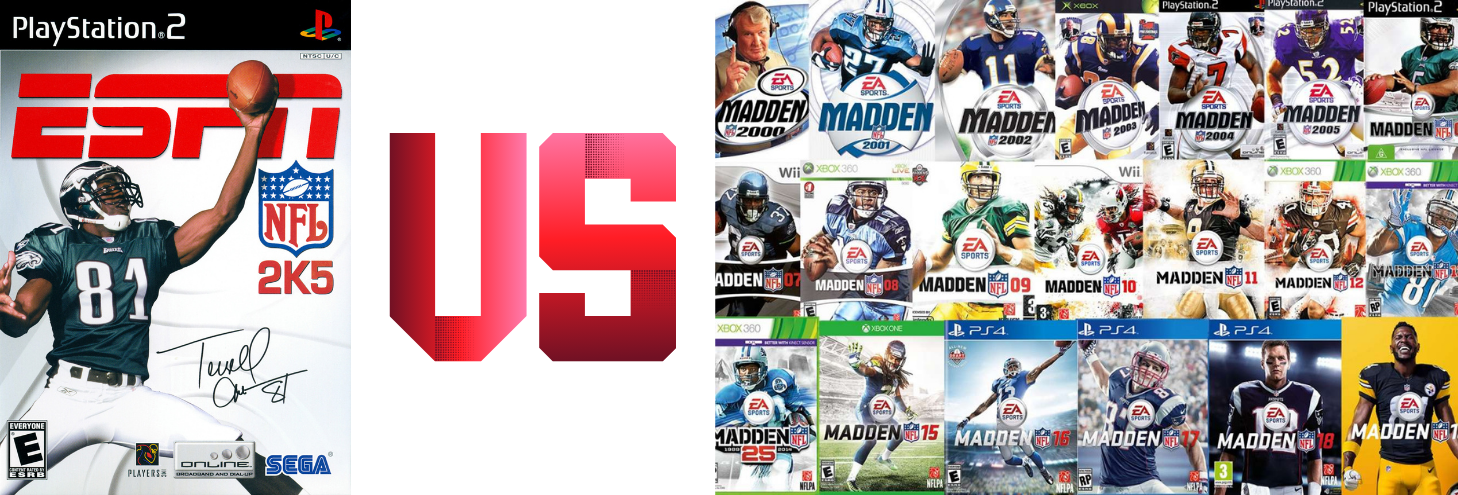
In the crowded arena of sports video games, few titles have ever posed a serious threat to EA’s long-dominant Madden NFL franchise. But in 2004, a challenger emerged that didn’t just compete, it rocked the football gaming world. ESPN NFL 2K5, developed by Visual Concepts and published by Sega, is still revered today as one of the greatest sports video games of all time. With innovative gameplay, unmatched presentation, and a shocking price point, 2K5 did what many thought was impossible: it made Madden look dated. Yet its brief triumph also set the stage for the very complacency that has plagued Madden ever since. ESPN 2K5 and Madden is the story of a game that dared to innovate, the monopoly it provoked, and the franchise that has been coasting on its victory ever since.
Bang For Your Buck
In an industry where new sports games routinely launched at $49.99 or more, NFL 2K5 made the audacious move to release at only $19.99. This aggressive pricing wasn’t just a marketing gimmick, it was a full-on assault on Madden’s market dominance. And gamers took notice.
True to its name, ESPN NFL 2K5 brought the television broadcast experience into the gaming world like never before. It wrapped every contest in authentic ESPN production values: crisp on-screen graphics, dynamic camera angles, and full pregame, halftime, and postgame shows complete with highlights packages. Actual ESPN talent brought it to life as Chris Berman and others delivered their signature commentary. It wasn’t just a game; it felt like you were watching (and participating in) an actual Sunday afternoon broadcast. Even two decades later, many fans argue its presentation still outshines modern Madden entries. For a fraction of the price, players were getting a full-featured, top-tier football experience.
Beyond its flash and flair, 2K5 delivered where it mattered most: on the field. The game featured smooth controls, responsive player movement, and smart AI that made games challenging and fun. Features like the “Maximum Tackle” system, first-person football mode, and nuanced play-calling added layers of depth and innovation that Madden had yet to touch. The animations were fluid, the physics were grounded, and the feeling of being “in the game” was second to none.
While Madden was still refining its franchise mode, 2K5 delivered one of the most robust sports simulation experiences of its era. It allowed for deep control of your team through trades, drafts, and contracts, all with an interface that was intuitive and fun. Then there was “The Crib,” a personal virtual space where players could customize their own living quarters with trophies, unlockables, music, and even mini-games. It was a quirky but charming addition that gave the game even more personality.
While Madden was still launching at full price, 2K5 delivered premium quality at a budget cost. Critics lavished it with praise: Game Informer called it “the best football title there is,” IGN awarded high 9s and Editor’s Choice honors, and many direct comparisons gave 2K5 the edge in graphics, presentation, special teams, and overall entertainment value. It earned end-of-year accolades and has since been hailed retrospectively as one of, if not the, greatest American football games ever made.
Let’s Make a Deal
The impact of 2K5 was so significant that EA moved swiftly to eliminate future competition. Just months after its release, EA signed an exclusive licensing deal with the NFL, effectively killing off the NFL 2K series and ensuring that only Madden could carry the official NFL branding. It was a controversial move, one that frustrated fans and raised questions about fair competition in the gaming industry. But it was also a testament to how disruptive and threatening 2K5 had become.
The NFL itself signed the exclusive deal in part because they didn’t like that their brand was being sold at such a dramatic discount. A premium league, they believed, deserved premium pricing. Yet that decision would have long-term consequences. Madden is the face of the NFL for a lot of people, especially younger fans who first became interested in football and the NFL through the game. For millions, Madden was the NFL experience. By locking the license behind one company, the league tied its digital identity to a single product line.
Fall of a Dynasty
When EA secured the exclusive NFL licensing deal in late 2004, just months after 2K5 hit shelves, Madden didn’t just win the battle. It eliminated the war entirely. Without any rival forcing it to evolve, the series no longer had to earn its place as the premier football game. It inherited it. The result has been two decades of what fans and critics alike describe as the illusion of progress: yearly releases that promise innovation but deliver mostly cosmetic tweaks, recycled assets, and a heavier emphasis on monetization than meaningful gameplay advancement.
The lack of competition has made EA complacent. There has been no external pressure to strive or innovate at the level seen during the 2K5 era. What followed was a slow erosion of ambition. Early post-monopoly titles still carried momentum from the competitive years with features like the Hit Stick in Madden 05, Superstar Mode, and deeper Franchise elements. But by the 2010s and beyond, the focus shifted dramatically. Recent iterations have largely prioritized visual polish, incremental gameplay tweaks, and especially the cash cow that is Ultimate Team, while the core simulation experience has been left to stagnate.
Annual Release
The biggest culprit is the relentless yearly release schedule. With a new Madden dropping every August like clockwork, development cycles are brutally short. Teams inherit the previous year’s engine, patch what they can, add a handful of new animations or mechanics, and ship it. The outcome is predictable: persistent bugs that carry over from title to title, half-baked features that feel like placeholders, and a sense that the game is more “updated roster” than true sequel. Even in Madden 26 (the latest entry at time of writing), reviewers noted that while some gameplay improvements (like refined passing and tackling systems borrowed from College Football) landed well, the overall package still felt like “the same game we’ve been playing for years with subtle tweaks.” Legacy issues, from AI pursuit angles to blocking logic, remain stubborn problems that never receive the time they deserve.
Ultimate Team
Nowhere is EA’s priorities clearer than in Madden Ultimate Team (MUT). This mode has become a financial juggernaut, generating hundreds of millions annually through pack openings, season passes, and cosmetic bundles. It functions like a digital casino designed to trigger dopamine hits and encourage spending for competitive edges online. The problem is that its overwhelming success has come at the direct expense of the rest of the game. Development resources are poured into MUT’s live-service elements, leaving offline modes to scrape by with minimal attention. Pay-to-win mechanics dominate the online experience, alienating casual and solo players who just want to build a dynasty or enjoy a realistic simulation. As one reviewer put it after Madden 26’s launch, MUT remains a “Skinner Box” that EA refuses to rein in because the money is simply too good.
Franchise Mode
For generations of fans, Franchise Mode was Madden. The deep, long-term simulation where you draft, trade, develop talent, and chase Super Bowls over multiple seasons. Yet it has been the poster child of neglect. For years, updates were incremental at best and nonexistent at worst. Madden 25 drew widespread criticism for putting Franchise on the “back burner,” delivering little beyond minor tweaks while promising more substantial changes that never materialized. Madden 26 finally delivered what EA billed as the “biggest Franchise overhaul in over a decade,” adding coach archetypes, abilities, and more strategic depth. But even that received mixed reactions: some praised the new tools, while others pointed out lingering bugs (like quarterback regression issues), unrealistic AI decision-making, and the sense that it was still playing catch-up rather than leading the way.
Compare that to the robust, personality-filled Franchise experience in NFL 2K5 two decades earlier, and the stagnation becomes glaring. Modes like Superstar (now rebranded as Face of the Franchise) have also seen only modest improvements, better than nothing, but nowhere near the innovation fans have begged for.
The New Standard
Because of the monopoly, “good enough” has become the new standard. Animations get reused across multiple titles. Presentation elements feel dated compared to what competitors in other sports have achieved. Load times drag, servers glitch, and technical issues that should have been ironed out years ago persist. Community forums and review aggregates are littered with the same complaints year after year: broken Franchise saves, unbalanced AI, and a general feeling that EA is coasting on the NFL brand rather than respecting it.
Sadly though, many fans still purchase Madden out of habit, nostalgia, or sheer lack of alternatives. They remember the glory days of Madden 2005’s immersive Franchise, Madden 10’s presentation upgrades, or even the defensive improvements in Madden 12. But each new release serves as a reminder that those heights are gone.
Nobody buys Madden because they like it; they buy it because they have no other option.
The Worst Company in America
To fully appreciate the irony of the NFL signing an exclusive deal with EA to “protect” its brand, consider what happened in 2012 and 2013. During those years, EA was voted the “Worst Company in America” by The Consumerist in public polls, becoming the first company ever to claim the dubious honor twice, consecutively no less.
In an article summarizing the win, The Consumerist asked the following:
“When we live in an era marked by massive oil spills, faulty foreclosures by bad banks, and rampant consolidation in the airline and telecom industry, what does it say about EA’s business practices that so many people have — for the second year in a row — come out to hand it the title of Worst Company In America?”
The reasons were wide-ranging: aggressive monetization practices, restrictive DRM policies, poor customer support, dismissive attitudes toward criticism, and a pattern of acquiring studios only to shut them down or gut their projects. While the backlash wasn’t aimed solely at Madden, the franchise’s monopoly played a significant role. Many voters felt EA was simply coasting on the NFL’s prestigious brand while delivering diminishing returns and prioritizing profits over quality.
Fast-forward to today, and you can’t help but laugh at the irony: the NFL’s brand is now represented by a product and a company that people openly hate. What began as a protective measure to safeguard the league’s image has instead saddled it with a digital flagship that many fans view with frustration and disappointment. The very game meant to introduce new generations to football has, for some, become a symbol of what happens when competition dies.
Competition Breeds Excellence
ESPN NFL 2K5 is more than just a football game, it’s a symbol of what can happen when creativity, quality, and competition align. It challenged an industry giant, redefined what sports games could be, and left behind a legacy that continues to inspire today. Despite being over 20 years old, 2K5 still has an active community. Modders continue to update rosters and tweak gameplay, keeping the experience alive long after its release. For many fans, it remains the gold standard of football gaming; a title that dared to innovate and, for a brief moment, unseat the king.
Meanwhile, Madden remains not just a bad game, but a frustrating one. It’s a franchise with the resources, legacy, and audience to truly be great, but it’s trapped in a cycle of safe plays and shallow upgrades. Modders on PC have taken it upon themselves to create custom rosters, improve visuals, and even add features EA has long ignored.
What Madden needs isn’t just a new coat of paint, it needs a philosophical reboot. One that values player experience, and prioritizes innovation over simple roster updates and microtransaction-driven content. EA must understand that its player base is not guaranteed, and to not assume that fans will automatically buy whatever is placed in front of them simply because it carries the NFL name. Until EA decides to break this cycle, Madden will remain a cautionary tale of a sports giant that mistook exclusivity for mastery. A reminder that competition drives excellence, and its absence breeds stagnation.
Two decades later, the “what-if” still lingers: What if the NFL had never locked the license behind one door? What if the pressure of a true rival had kept EA sharp?
NFL 2K5 showed the world what was possible when a challenger stepped onto the field. Its legacy, and Madden’s ongoing struggle, proves that even the mightiest throne can be shaken when someone dares to play a better game.