
Traditional television news broadcasts once functioned primarily as vehicles for reporting events to a broad audience. Major broadcast networks (ABC, CBS, NBC) and emerging cable channels delivered reporting that commanded broad public confidence. In recent decades, however, they have moved toward commentary and interpretation, resulting in a political bias that has intensified through a combination of regulatory changes, audience fragmentation, financial incentives, and competitive pressure from social media and independent creators. Legacy outlets no longer primarily break news for most viewers; they provide commentary on stories already circulating elsewhere. This interpretive role inherently involves perspective and therefore bias.
The Fairness Doctrine
For much of the broadcast era, the three dominant broadcast networks operated under the FCC’s Fairness Doctrine, established in 1949. This policy required holders of broadcast licenses to devote airtime to controversial issues of public importance and to present them in a manner that fairly reflected contrasting viewpoints. Polls from the era reflected high confidence: roughly 70% of Americans in the 1960s and early 1970s viewed network news as fair. The Fairness Doctrine was repealed in 1987, and its removal opened the way for more explicitly opinionated formats. Cable news expanded rapidly in this environment. CNN launched in 1980; Fox News and MSNBC followed in 1996. These 24-hour channels competed for attention in an increasingly fragmented media marketplace where audience retention and engagement became central to revenue.
Competing for attention in a fragmented environment favors content that sustains engagement. Under the economic pressure of keeping a billion-dollar studio afloat, there was a gradual shift toward content that aligns with audience priors, as it tends to retain viewers more effectively than a neutral telling of known facts. Over time, especially after the widespread adoption of social media, the distinction between reporting facts and offering commentary blurred further. Legacy outlets increasingly layered interpretation, context, and perspective onto events.
What was lost in this transition is the recognition that effective commentary is a skill not everyone possesses. A clumsy attempt can easily come across as off-putting or even insulting. When done well, commentary adds value through context, but even then, it inevitably embeds the commentator’s perspective, which inherently involves selection and framing, which introduces opinion and, by extension, bias.
A Study in Bias
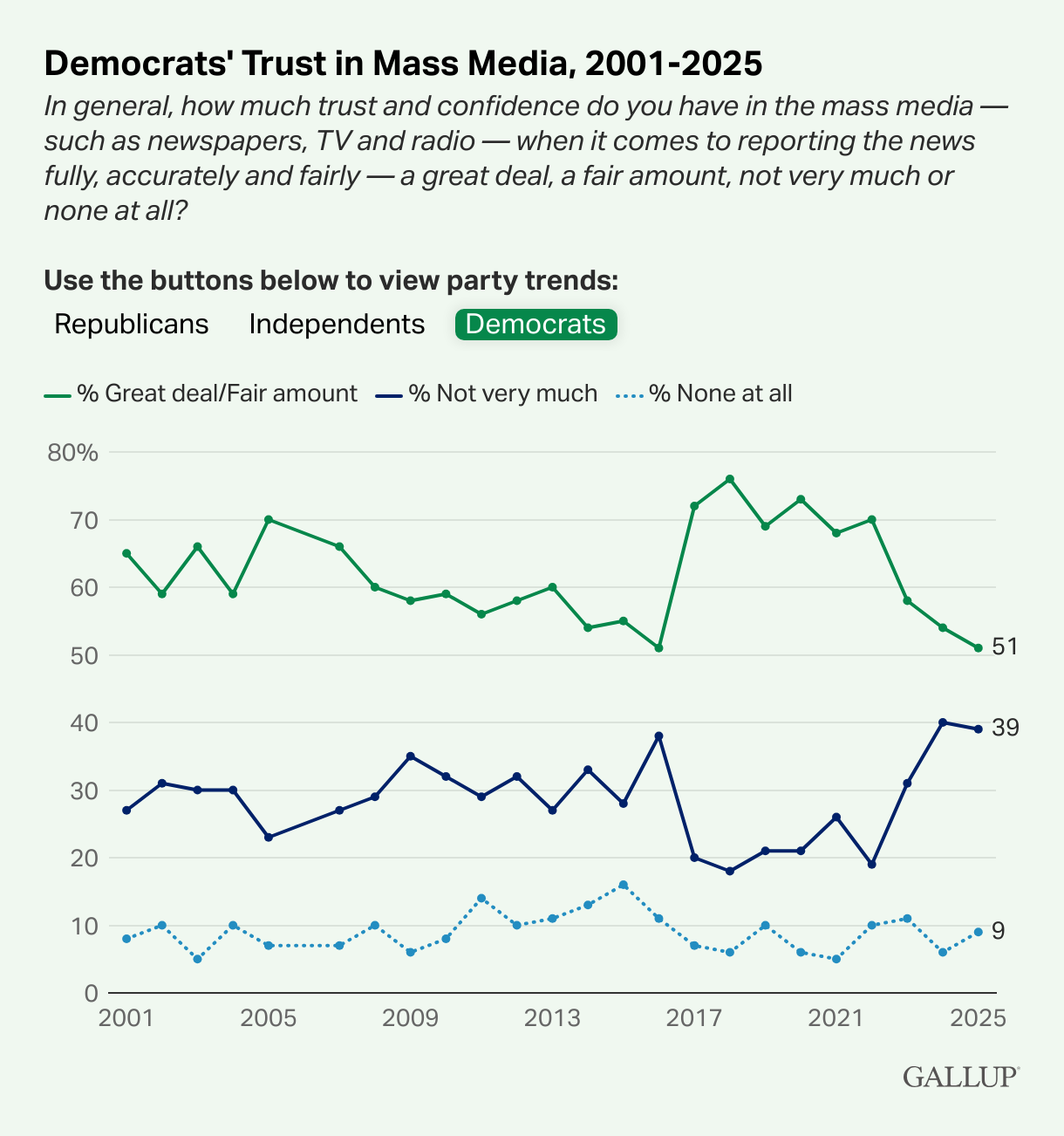
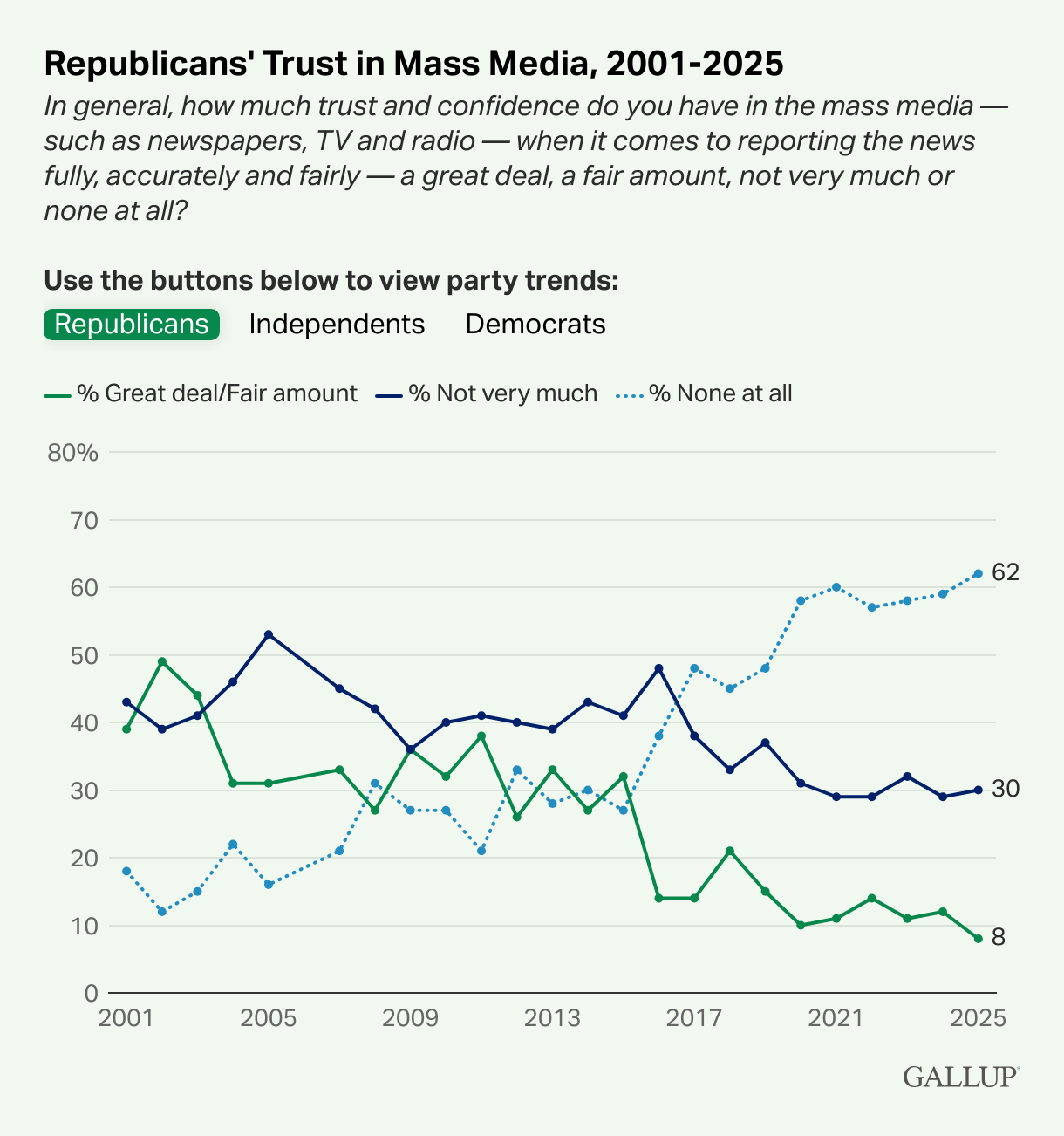
Public trust in mass media has reached historic lows. A September 2025 Gallup poll found that only 28 percent of Americans express a “great deal” or “fair amount” of confidence that newspapers, television, and radio report the news fully, accurately, and fairly. This marks a new low and continues a long decline from the 60-70 percent range common in the 1970s. The partisan differences are stark, with 51% of Democrats versus 8% of Republicans.
Consumption and trust patterns align sharply with political affiliation. Pew Research Center data show that Republicans rely heavily on Fox News (57% regular use) while expressing low trust in ABC, CBS, NBC, CNN, and MSNBC. Democrats report high regular use and trust across the broadcast networks and CNN/MSNBC, with much lower trust in Fox News.
A 2022 study in the Proceedings of the National Academy of Sciences analyzed thousands of hours of CNN, Fox News, and MSNBC programming from 2010 to 2020. Researchers used the ideological leanings of on-screen guests as a proxy for “visibility bias.” All three networks grew more polarized over the decade. Fox News moved further right; CNN and MSNBC moved further left, with the gap widening notably after the 2016 election. This divergence was driven primarily by primetime programming, while daytime and morning shows focused more on hard news.
These leanings can become apparent when examining the content closely. Bias appears through several consistent mechanisms:
Story selection and emphasis: Outlets choose which events, data, or developments to highlight or downplay.
Framing and language: Word choice, headlines, and visuals can cast the same facts in favorable or unfavorable light.
Source and guest selection: The ideological distribution of experts, officials, and analysts shapes the range of perspectives presented.
The Competitive Imperative
Social media has fundamentally altered news consumption. Today, over half of Americans receive their news from social media. Events often break and spread first on digital platforms, and by the time traditional broadcasts air, audiences have typically encountered the core facts elsewhere. This timing shift transformed the role of legacy television from primary reporter to commentator on already-public information.
In this new era, audiences (especially younger viewers) began turning to independent creators and streamers precisely because they feel more authentic and relatable. Social media personalities often deliver straightforward opinions without the layered production of a television studio. They appear more in touch with everyday concerns and less filtered by institutional processes. They also enjoy greater operational freedom: they can go live whenever they choose, face fewer time constraints, and are often less bound by restrictions on language or subject matter.
There is a clear economic advantage. Social media and streaming platforms can deliver news commentary at a fraction of traditional production costs. With the basic platform free to use (aside from optional premium features), all that is needed is a computer, a camera, and a microphone. This more personable format also supports stronger engagement, most notably through the use of a live viewer chat that allows the streamer to answer audience questions in real-time.
There is also a structural advantage in how content is presented. Consider the simple act of commenting on a video clip. A single streamer often controls the clip directly, pausing, rewinding, revisiting points, and adjusting the analysis on the fly. This creates a far more organic and adaptive workflow.
Traditional television operates under a much more rigid structure. A host typically works within a controlled environment where producers manage clip playback from off-camera. The format allows limited real-time revision, and the involvement of multiple personnel and technical layers adds overhead while reducing spontaneity. What registers to some audiences as polished professionalism can appear to others as distant and scripted.
The homegrown, less formal aesthetic common among successful independent creators contributes to their appeal. It signals directness rather than institutional polish. Audiences seeking an unmediated perspective often prefer this approach over highly produced broadcasts. Legacy outlets responded to this competition by emphasizing commentary and perspective. In doing so, however, they no longer had anything fundamentally unique to offer.
When outlets shift from straight reporting to commentary, they supply context and perspective. This interpretive layer reflects the commentator’s judgments about what matters, how events connect, and which implications deserve emphasis. Different outlets apply different lenses, producing diverging narratives around the same underlying facts.
The real-time flexibility available to independent creators allows immediate reaction and clarification. Traditional linear formats, constrained by production workflows, offer less room for such adjustments once a segment begins. That structure reinforces the perception that legacy commentary is largely predetermined.
Size Matters
It is important to note that independent streamers and social media personalities who provide commentary are themselves also biased. Their perspectives reflect personal viewpoints, selective framing, and audience preferences, just as legacy commentary does. This is a fair observation: no commentator operates in a vacuum, and digital creators often cultivate followings by delivering opinionated analysis that resonates with specific demographics.
However, traditional outlets’ adoption of this commentary-heavy format carries distinct implications due to their established television platforms and massive reach. Broadcast and cable networks still command large, diverse audiences that include viewers who treat them as authoritative or near-neutral sources of information. When these institutions shift toward interpretation of known events, the resulting bias is amplified across broader portions of the population. A streamer’s opinion may influence thousands or even millions within niche communities, but a primetime segment on a major network can shape perceptions for tens of millions in a single airing, often among demographics less inclined to seek out alternative digital voices.
While digital creators offer transparency and personability, the transition of traditional broadcasting to the same type of content arguably compounds the problem by leveraging the weight and influence of their established platforms. Both sides exhibit bias through commentary, but the institutional reach of legacy outlets gives their version enormous potential to influence public discourse.
The New Normal
By the time many viewers sit down for evening broadcasts, major stories have already circulated widely through social platforms, independent creators, and real-time updates. Television news often arrives as secondary commentary rather than primary information. Viewers are frequently told what they already know, accompanied by analysis that reflects the outlet’s perspective. The combination of this pre-existing awareness and heavy reliance on interpretive commentary has accelerated audience fragmentation. Viewers increasingly select sources whose commentary style and perspective match their own. This dynamic reduces exposure to competing frames and contributes to the erosion of shared factual baselines.
Traditional broadcasts retain advantages in resources, access, and editorial infrastructure. Yet the structural rigidity of studio production, higher overhead costs, limited real-time audience engagement, and less flexible workflows create inherent disadvantages in matching the immediacy that audiences now expect. The migration toward digital personalities stems from clear preferences for authenticity, relatability, and real-time adaptability. Economic realities have compelled legacy media to emphasize the same commentary format as a survival strategy. When these organizations adopt this model more fully to remain competitive, the line between reporting and opinion narrows further across the board.
These developments have produced a more polarized information landscape. With social media and independent digital platforms showing no signs of declining influence, this fragmented, opinion-driven coverage is likely to solidify as the new normal rather than a temporary disruption. Restoring broader credibility would require legacy organizations to confront both the production constraints that limit spontaneity and the audience demand for directness that social media formats have normalized.